Virtual Terminal Merchant Account: Complete MOTO Payment Guide 2026
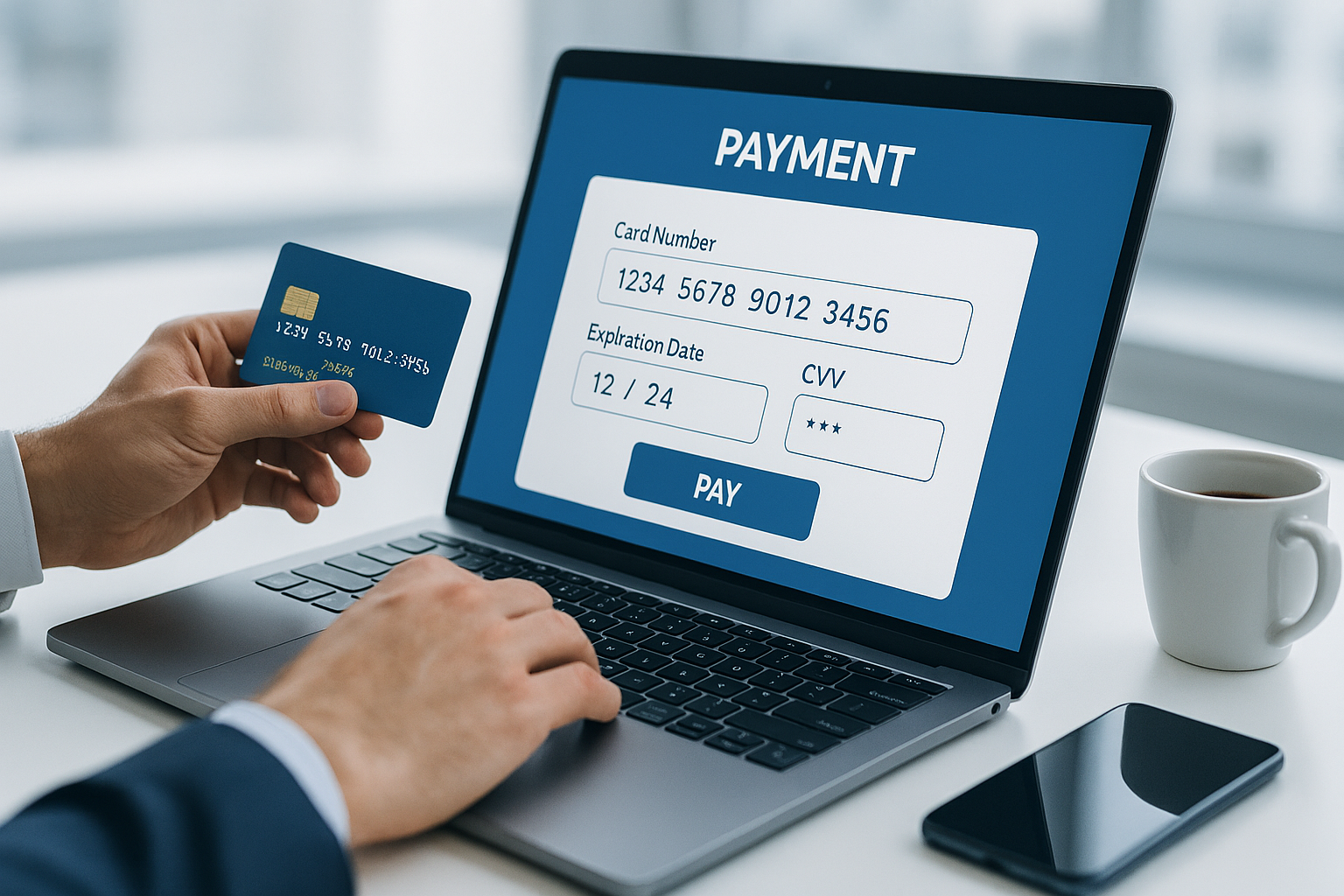
Processing $10,000+ monthly in phone orders or mail orders but can't get approved for a merchant account? You're not alone. Over 40% of businesses needing virtual terminal or MOTO (Mail Order/Telephone Order) payment processing face rejections from traditional banks due to card-not-present transaction risks.
Whether you run a call center, service business, nonprofit, or B2B company that processes payments over the phone or by mail, this complete guide walks you through everything you need to know about virtual terminal merchant accounts in 2026—from understanding MOTO payments to getting approved in 24-48 hours.
What is a Virtual Terminal Merchant Account?
A virtual terminal merchant account allows businesses to process credit card payments without physical card readers. Instead of swiping or inserting cards, you manually enter (key in) payment information through a secure web-based interface accessible from any computer, tablet, or smartphone with internet connection.
Understanding MOTO (Mail Order/Telephone Order) Payments
MOTO payments are card-not-present (CNP) transactions where the customer isn't physically present during payment processing. This category includes:
- Telephone orders: Customer provides card details over the phone to your sales or customer service team
- Mail orders: Customer sends payment information via postal mail, fax, or email
- Recurring billing: Subscription services charging stored payment methods monthly/annually
- Invoice payments: B2B customers paying invoices by providing card information remotely
Virtual terminals serve as the processing platform for all these MOTO payment types, providing a secure, PCI-compliant method to accept payments without customers being physically present.
Key Difference: Virtual terminals process card-not-present transactions, while traditional POS systems handle card-present transactions (customer physically swipes/inserts card). CNP transactions carry higher fraud risk, which is why virtual terminal merchant accounts are classified as high-risk and require specialized processors.
Virtual Terminal vs. Payment Gateway vs. POS
Understanding these distinctions helps you choose the right payment processing solution:
| Solution Type | Best For | Transaction Type | Equipment Needed |
|---|---|---|---|
| Virtual Terminal | Phone orders, mail orders, invoices | Card-not-present (CNP) | Computer/tablet with internet |
| Payment Gateway | E-commerce websites, online stores | Card-not-present (CNP) | Website integration (API) |
| POS Terminal | Retail stores, in-person sales | Card-present | Physical card reader/terminal |
Many businesses use multiple solutions. For example, a service company might use a virtual terminal for phone orders, a payment gateway for online bookings, and mobile POS for in-field payments.
Who Needs a Virtual Terminal Merchant Account?
Virtual terminal accounts are essential for:
- Call centers: Inbound/outbound sales teams processing orders over phone
- Service businesses: HVAC, plumbing, consulting firms taking deposits/payments remotely
- Nonprofits: Processing phone/mail donations from supporters
- B2B companies: Accepting payment for invoices, wholesale orders, large contracts
- Professional services: Attorneys, accountants, healthcare providers billing clients
- Subscription services: Monthly/annual billing for memberships, software, services
- Travel agencies: Booking reservations and processing payments remotely
- Event planners: Taking deposits and final payments for venues, catering, services
If your business processes more than 30% of transactions without the customer's physical card present, you need a virtual terminal merchant account. Apply for a virtual terminal account with EnergyCore to start processing MOTO payments within 48 hours.

How MOTO Payments Work: Step-by-Step Process
Understanding the MOTO payment flow helps you optimize operations and reduce fraud risk.
Step 1: Customer Initiates Payment
The customer contacts your business via phone, mail, email, or fax to place an order or make a payment. They provide their credit/debit card information verbally or in writing.
Step 2: Employee Accesses Virtual Terminal
Your team member logs into the secure virtual terminal platform using unique credentials. Multi-user accounts allow tracking which employee processed each transaction for accountability and security.
Step 3: Manual Data Entry
The employee manually enters (keys in) the payment information:
- Cardholder name
- Card number (16 digits for most cards)
- Expiration date (MM/YY)
- CVV/CVC security code (3-4 digits on back of card)
- Billing address for AVS (Address Verification System) check
- Transaction amount
- Order/invoice number for reference
Step 4: Security Verification
The virtual terminal runs automated fraud prevention checks:
- AVS (Address Verification System): Compares billing address with card issuer records
- CVV verification: Confirms the security code matches card issuer data
- Velocity checks: Flags multiple transactions from same card in short timeframe
- Blacklist screening: Checks card against known fraud databases
Step 5: Authorization Request
The payment processor sends an authorization request to the customer's card-issuing bank through the card network (Visa, Mastercard, etc.). The bank either approves or declines the transaction within 2-3 seconds.
Step 6: Transaction Completion
Upon approval, the virtual terminal displays a confirmation with authorization code. The employee provides the customer with a confirmation number and processes their order. The transaction amount is debited from the customer's account and credited to your merchant account within 1-2 business days (settlement period).
Step 7: Record Keeping
All virtual terminal transactions are automatically logged with timestamps, employee IDs, customer information, and transaction details. This creates an audit trail for accounting, customer service, and dispute resolution.
Ready to Start Processing MOTO Payments?
Get approved for a virtual terminal merchant account in 24-48 hours with transparent pricing
Apply Now - Instant QuoteWhy Traditional Banks Decline MOTO Merchant Accounts
Understanding why banks reject virtual terminal applications helps you position your business correctly when applying to specialized processors.
1. Card-Not-Present (CNP) Transaction Risk
MOTO transactions carry significantly higher fraud risk than card-present transactions. When customers aren't physically present, criminals can use stolen card data to make unauthorized purchases. Card-present transactions using EMV chip readers have fraud rates around 0.05%, while card-not-present transactions average 0.5-1.5% fraud rates—up to 30 times higher.
Banks lose money on fraudulent transactions through chargebacks, so they avoid industries with elevated CNP volumes.
2. Higher Chargeback Rates
MOTO businesses typically experience chargeback rates of 1-2%, compared to 0.5-1% for retail businesses. Chargebacks occur when customers dispute transactions with their card issuer, claiming:
- They never received the product/service
- The product was significantly different than described
- They were charged the wrong amount
- Their card was used without authorization
Each chargeback costs merchants $15-$100 in fees, plus the reversed transaction amount. High chargeback rates trigger penalties from card networks and can result in merchant account termination.
3. Lack of Physical Card Verification
Without seeing the physical card, verifying the customer's identity becomes challenging. While AVS and CVV checks help, they're not foolproof. Criminals with complete stolen card data can bypass these security measures.
Traditional banks prefer businesses that can physically verify cards through EMV chip readers or contactless payments, which provide stronger fraud protection.
4. Industry-Specific Risk Factors
Certain industries commonly using virtual terminals face additional scrutiny:
- Telemarketing/outbound sales: Higher consumer complaint rates, regulatory oversight
- Subscription services: Recurring billing creates ongoing chargeback exposure
- CBD/nutraceuticals: Regulatory uncertainty, elevated chargeback patterns
- Adult services: Reputational risk for conservative banks
- Travel/events: Long time between payment and service delivery increases dispute risk
These industries need specialized high-risk merchant account providers who understand their unique challenges. EnergyCore serves all high-risk industries with virtual terminal solutions designed for elevated-risk businesses.
5. PCI Compliance Concerns
Virtual terminals must maintain strict PCI DSS (Payment Card Industry Data Security Standard) compliance to protect cardholder data. Banks worry that businesses manually handling card information may not have adequate security measures, creating liability exposure.
Proper PCI compliance requires employee training, secure data handling procedures, encrypted storage, and regular security audits—requirements many small businesses struggle to maintain.
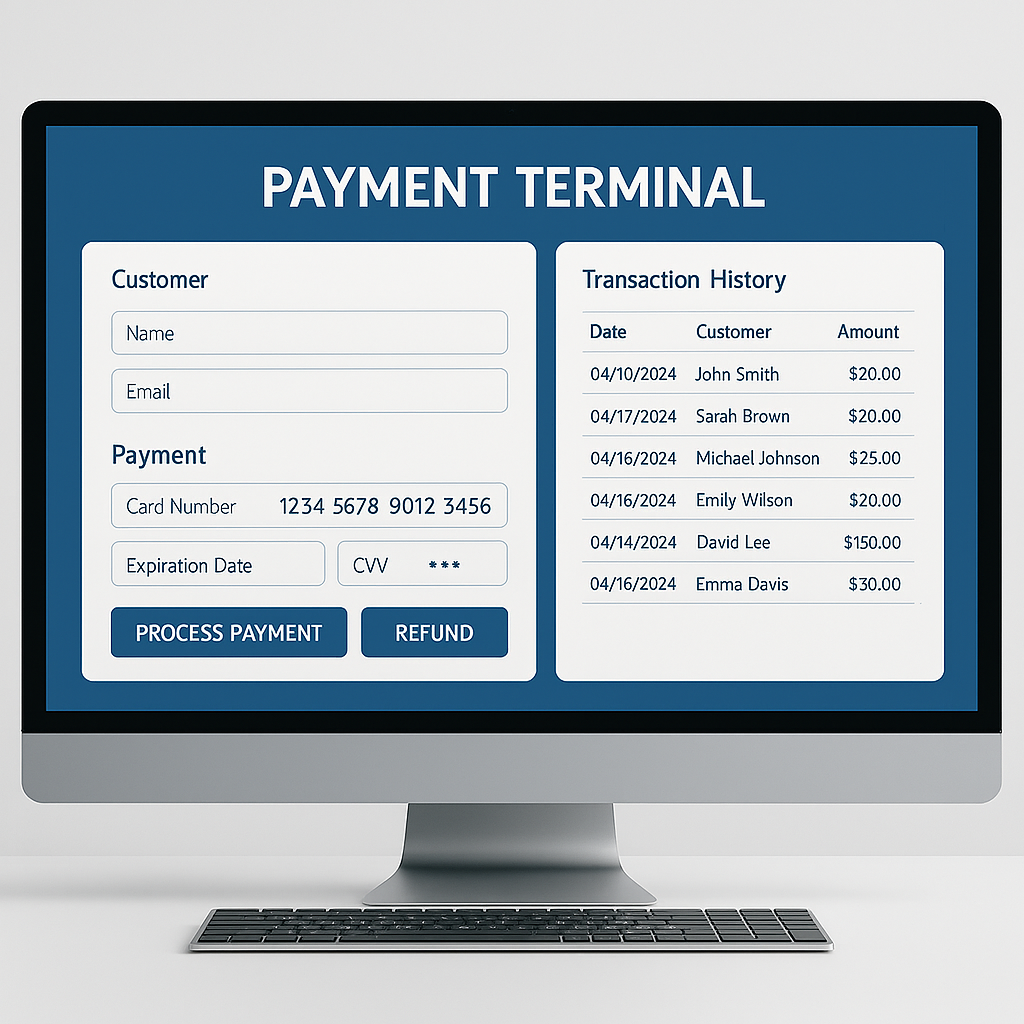
Virtual Terminal Features to Look For
Not all virtual terminal platforms offer the same capabilities. Choose a solution with these essential features:
1. Multi-User Access with Permission Levels
Allow multiple employees to process payments while maintaining security and accountability. Features include:
- Individual login credentials for each user
- Customizable permission levels (admin, manager, standard user)
- Transaction audit trails showing which employee processed each payment
- Ability to restrict refund/void permissions to supervisors only
2. Recurring Billing Capability
Essential for subscription businesses, membership organizations, and service contracts. Quality recurring billing features include:
- Automated monthly/annual charging on scheduled dates
- Customer payment profiles storing card data securely (tokenization)
- Failed payment retry logic with automatic notification
- Subscription management (pause, cancel, modify payment amounts)
- Dunning management to recover failed payments
3. Customer Database & CRM Integration
Store customer information for repeat transactions and business intelligence:
- Customer profiles with contact information, payment history
- Quick payment processing for returning customers
- Integration with CRM systems (Salesforce, HubSpot, Zoho)
- Customer lifetime value tracking
4. Comprehensive Reporting and Analytics
Make data-driven decisions with robust reporting:
- Transaction reports (daily, weekly, monthly)
- Settlement reports showing batch deposits
- Chargeback reports with dispute tracking
- Employee performance metrics (transactions per user)
- Export capabilities (CSV, PDF) for accounting software
- Real-time dashboards showing processing volume, approval rates
5. Mobile Accessibility
Process payments from anywhere with mobile-optimized platforms:
- Responsive web design accessible on smartphones/tablets
- Native mobile apps for iOS/Android
- Same security and features as desktop version
- GPS location tracking for in-field transactions
6. Advanced Refund & Void Processing
Handle customer service issues efficiently:
- Full or partial refund capabilities
- Void transactions before settlement (no processing fees)
- Refund tracking and reporting
- Automated email receipts for refunds
7. Fraud Prevention Tools
Minimize chargebacks and fraudulent transactions:
- Real-time AVS and CVV verification
- Velocity filters (multiple transactions from same card)
- IP address geolocation checking
- Blacklist management (block specific cards/customers)
- Transaction limit controls (maximum amounts per transaction/day)
- 3D Secure authentication for higher-risk transactions
EnergyCore's virtual terminal platform includes all these features with 24/7 technical support and dedicated account management.
How to Get Approved for a MOTO Merchant Account: Step-by-Step
Follow this proven process to maximize your approval odds and expedite setup.
Step 1: Gather Required Documentation (1-2 Days)
Prepare these documents before starting your application:
- Business formation documents: LLC/corporation paperwork, DBA filing, EIN letter
- Business license: Current license for your state/municipality
- Bank statements: 3-6 months showing business revenue and financial stability
- Processing history: Statements from previous merchant accounts (if applicable) showing transaction volumes and chargeback rates
- Personal identification: Government-issued ID for all owners with 25%+ ownership stake
- Website or marketing materials: Proof of legitimate business operations
- Customer service procedures: Documentation of how you handle orders, customer complaints, refunds
- Financial projections: Expected monthly processing volume, average transaction size, anticipated growth
Step 2: Choose a MOTO-Friendly Payment Processor
Not all processors accept virtual terminal merchants, especially in high-risk industries. Look for:
- Proven experience with MOTO/CNP transactions
- Transparent fee structures (avoid hidden monthly fees)
- Fast approval timelines (24-48 hours vs. weeks)
- Month-to-month contracts (avoid long-term lock-ins)
- Dedicated support teams familiar with your industry
- Comprehensive virtual terminal features
EnergyCore Merchant Services specializes in MOTO merchant accounts across all industries, including high-risk verticals traditional banks decline.
Step 3: Complete the Application
Fill out the processor's application completely and accurately. Most applications take 15-30 minutes and request:
- Business information (legal name, DBA, EIN, address)
- Owner information (names, SSNs, ownership percentages)
- Business model details (how you acquire customers, fulfillment process)
- Processing estimates (monthly volume, average ticket, highest ticket)
- Current/previous merchant account history
Pro tip: Be completely transparent about your business model. Attempting to hide MOTO transactions or misrepresent your industry will result in immediate account termination when discovered during monitoring.
Step 4: Underwriting Review (24-48 Hours)
The processor's underwriting team reviews your application and documentation. They assess:
- Business legitimacy and compliance
- Financial stability and creditworthiness
- Industry risk factors
- Chargeback risk based on business model
- Processing history (if applicable)
MOTO merchant accounts typically receive decisions within 24-48 hours for complete applications. Traditional banks may take 2-4 weeks.
Step 5: Account Setup and Virtual Terminal Configuration (1-2 Days)
Upon approval, you'll receive:
- Merchant account credentials (MID, gateway login)
- Virtual terminal access with user guides
- Setup assistance from account manager
- Employee training materials
- PCI compliance documentation and requirements
Most virtual terminals are cloud-based and ready to use immediately—no hardware installation required.
Step 6: Employee Training and PCI Compliance (1-2 Days)
Train your team on:
- Proper card data handling (never write down full card numbers)
- Virtual terminal interface and features
- Fraud prevention best practices
- Customer verification procedures
- PCI compliance requirements
Complete annual PCI self-assessment questionnaires (SAQ) to maintain compliance and avoid penalties.
Step 7: Go Live and Monitor Performance
Process your first transactions and monitor closely for 30 days:
- Track approval rates (should be 85-95% for legitimate transactions)
- Monitor chargeback rates (keep below 1%)
- Review settlement times (funds should arrive in 1-2 business days)
- Communicate regularly with account manager
Maintaining low chargeback rates and strong processing history may qualify you for fee reductions after 3-6 months.
Start Processing Virtual Terminal Payments in 48 Hours
Complete application in 15 minutes. Get dedicated support and transparent pricing.
Get Your Instant QuoteTop Virtual Terminal Merchant Account Providers 2026
These processors offer reliable MOTO payment processing with proven track records.
1. EnergyCore Merchant Services (Recommended)
EnergyCore specializes in virtual terminal merchant accounts for both standard and high-risk businesses. With 24-48 hour approvals and comprehensive MOTO features, EnergyCore serves call centers, service businesses, nonprofits, and industries traditional banks decline.
Key advantages:
- Fast approvals (24-48 hours with complete applications)
- Transparent pricing with no hidden fees
- Multi-user virtual terminal with advanced features
- Recurring billing and customer database included
- Dedicated account managers with industry expertise
- Month-to-month contracts (no long-term commitments)
- Support for high-risk industries (CBD, adult, nutraceuticals, etc.)
- Integration with major CRM and accounting platforms
Best for: Service businesses, call centers, high-risk industries, businesses needing flexible contracts and dedicated support.
Apply for EnergyCore virtual terminal merchant account
2. Authorize.Net
Long-established payment gateway with virtual terminal capabilities. Widely used and integrated with most e-commerce platforms and shopping carts.
Best for: E-commerce businesses needing both gateway and virtual terminal, companies wanting extensive third-party integrations.
3. Square Virtual Terminal
Simple virtual terminal for low-volume businesses. Easy setup but limited features and strict industry restrictions.
Best for: Very small businesses with occasional phone orders, low-risk industries only (excludes CBD, adult, many service industries).
4. PayPal Virtual Terminal
Basic MOTO processing for PayPal business accounts. Limited customization and reporting capabilities.
Best for: Existing PayPal users wanting simple phone order processing, very small transaction volumes.
Comparison: Why EnergyCore for MOTO Processing
While alternatives exist, EnergyCore offers unique advantages for MOTO merchants:
- High-risk acceptance: Unlike Square/PayPal, EnergyCore approves industries traditional processors decline
- Dedicated support: Personal account managers vs. generic call centers
- Flexible contracts: Month-to-month vs. 3-year commitments
- Advanced features: Comprehensive virtual terminal vs. basic keying capabilities
- Competitive pricing: Transparent rates vs. hidden fees and rate increases
MOTO Payment Processing Fees: What to Expect
Understanding virtual terminal pricing helps you budget accurately and compare providers.
Typical MOTO Processing Rates
Card-not-present transactions cost more than card-present due to higher fraud risk:
- Transaction rate: 3.5-5.5% + $0.20-$0.30 per transaction
- Gateway fee: $15-$50 monthly
- Statement fee: $10-$25 monthly
- PCI compliance fee: $79-$149 annually (or monthly $6.95-$12.95)
- Batch settlement fee: $0-$0.25 per day
- Chargeback fee: $15-$100 per dispute
Why MOTO Costs More Than Card-Present
Virtual terminal rates are higher because:
- Interchange fees: Card networks charge higher interchange for CNP transactions (2.3-2.9% vs. 1.5-2.3% for card-present)
- Risk premiums: Processors add markup to cover elevated fraud/chargeback exposure
- No EMV protection: Missing chip card security increases liability
How to Reduce MOTO Processing Fees
Lower your costs with these strategies:
- Maintain low chargebacks: Under 0.5% qualifies for rate reductions
- High processing volume: $50K+ monthly often qualifies for volume discounts
- Use AVS and CVV: Qualifying for lower interchange categories
- Batch daily: Avoid non-qualified surcharges from delayed batching
- Negotiate after 6 months: Strong processing history gives leverage for better rates
Get transparent pricing from EnergyCore with no hidden fees or rate increase clauses.
Best Practices for MOTO Security and Fraud Prevention
Protect your business and customers with these proven security measures.
1. Verify Customer Information
- Always request and verify CVV security codes
- Confirm billing address and use AVS verification
- For high-value transactions, call customer back at number on file
- Verify email addresses for order confirmations
- Request government ID for large or suspicious orders
2. Implement Transaction Limits
- Set maximum transaction amounts requiring supervisor approval
- Limit transactions per card per day
- Flag duplicate orders from same customer in short timeframe
- Require additional verification for orders exceeding average ticket
3. Train Employees on Red Flags
Educate staff to recognize fraudulent transaction indicators:
- Customer rushes transaction or seems nervous
- Shipping address differs from billing address
- Customer unable to provide CVV or billing address
- Large order from first-time customer
- Multiple cards attempted for same transaction
- Expedited shipping requests for expensive items
4. Maintain PCI Compliance
- Never write down full card numbers
- Avoid storing CVV codes (violation of PCI rules)
- Use encrypted storage for customer payment profiles
- Limit access to cardholder data on need-to-know basis
- Complete annual PCI self-assessment questionnaires
- Use PCI-compliant virtual terminal platforms only
5. Document Everything
- Keep detailed transaction logs (date, time, employee, customer info)
- Save all order confirmations and shipping receipts
- Record customer communication (calls, emails) for dispute evidence
- Maintain proof of delivery for shipped items
6. Respond Quickly to Chargebacks
- Contest illegitimate chargebacks within deadline (typically 7-10 days)
- Provide compelling evidence (signed receipts, delivery confirmation, customer communication)
- Track chargeback reasons to identify patterns
- Improve processes based on chargeback analysis
Frequently Asked Questions (FAQ)
What is the difference between a virtual terminal and payment gateway?
A virtual terminal is a web-based interface where employees manually enter card information for phone/mail orders. A payment gateway is software that integrates with your website to process online payments automatically when customers checkout. Virtual terminals are for human-keyed transactions; gateways are for automated e-commerce transactions. Many providers offer both capabilities.
How long does virtual terminal merchant account approval take?
With complete documentation, MOTO merchant account approval typically takes 24-48 hours from specialized processors like EnergyCore. Traditional banks may require 2-4 weeks. High-risk industries or businesses with processing history issues may take 3-5 days for additional underwriting review.
Can I use Square or Stripe for MOTO payments?
Square offers virtual terminal capabilities for low-volume businesses in approved industries only. Stripe does not offer virtual terminal functionality (gateway only). Both prohibit many industries including CBD, adult services, and various high-risk verticals. For reliable MOTO processing without industry restrictions, use specialized providers like EnergyCore Merchant Services.
What are typical fees for virtual terminal merchant accounts?
MOTO processing fees range from 3.5-5.5% per transaction plus $0.20-$0.30 per transaction. Monthly fees include gateway ($15-$50), statement ($10-$25), and PCI compliance ($6.95-$12.95 monthly or $79-$149 annually). High-risk industries typically pay toward the higher end of these ranges due to elevated chargeback exposure.
Is a virtual terminal PCI compliant?
Reputable virtual terminal platforms are PCI DSS compliant, meaning they meet payment card industry security standards. However, your business must also maintain PCI compliance through proper employee training, secure data handling, and annual self-assessment questionnaires. Never store full card numbers or CVV codes outside PCI-compliant systems.
Can I process recurring billing through a virtual terminal?
Yes, quality virtual terminal platforms include recurring billing features for subscription services and membership organizations. This allows you to securely store customer payment profiles (tokenized card data) and automatically charge scheduled payments monthly, quarterly, or annually. EnergyCore's virtual terminal includes comprehensive recurring billing with failed payment management.
Start Processing Virtual Terminal Payments Today
Don't let merchant account rejections prevent your business from accepting phone orders, mail orders, and remote payments. With the right MOTO merchant account provider, you can process card-not-present transactions securely and reliably within 48 hours.
Apply now for a virtual terminal merchant account with EnergyCore Merchant Services and join thousands of businesses processing MOTO payments with transparent pricing, dedicated support, and industry-leading technology.
Questions about virtual terminal merchant accounts or MOTO payment processing? Contact our team for a free consultation. We're here to help your business succeed with reliable, secure payment processing.
Get Approved for MOTO Processing in 24-48 Hours
Transparent pricing • No hidden fees • Month-to-month contracts • Expert support
Start Your Application Now